 Kanada FR
 USA
USA Großbritannien
 Europäische Union
 New Zealand
 Australia

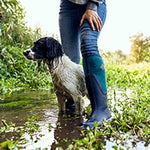
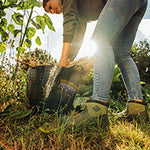
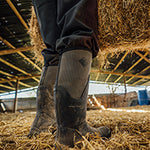
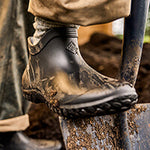
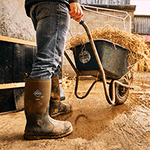





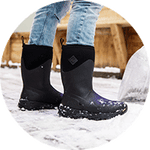




Have you ever seen a wellington boot bird box? Neither had we, until someone from our incredible community reached out to let us know they had created exactly that! Over the years we’ve had many photos sent in of our wellington boots being given a new purpose. This ranges from plant pots to umbrella stands, and we are always delighted to hear how our boots are being given a new lease of life in a slightly different way. As a brand that prides itself on functionality, we are so grateful to Chris Sharples, Head Gardener at Watts Gallery, for sharing this incredible idea of upcycling old boots with us.


Chris shares his story and the inspiration behind this idea with us below.
“I was given a pair of Muck Boots for my birthday years ago, and as things do, after a lot of wear they sprung a leak. They hung around in the shed for quite a while, I even thought maybe I could plant something in them. Then the idea came to me to convert the defunct boots into a pair of bird boxes as their warm, dry, solid nature makes them perfect. I checked the internet for the size of hole required for a given bird, then with a craft knife cut a hole in the side of the boot about two-thirds of the way up. I made sure to leave a little flap, which I then, using wire, converted into a little porch roof over the entrance hole. I chose a size suitable for blue tits and coal tits. I stuffed the toe of the boot with filler material, leaving the ankle area free for the nesting chamber. Using a flat awl and wire, I cinched the top of the boot shaft closed and then fashioned a wire hook for hanging. There are plenty of guides on the internet for hanging a nesting box correctly (the RSPB has good advice). Ours are now hanging and distributed around the garden ready, hopefully, to be taken possession of by some residents in the spring. Once the nest is no longer required, the wire can be undone and the nesting detritus removed for the nesting box to be used again next year.”